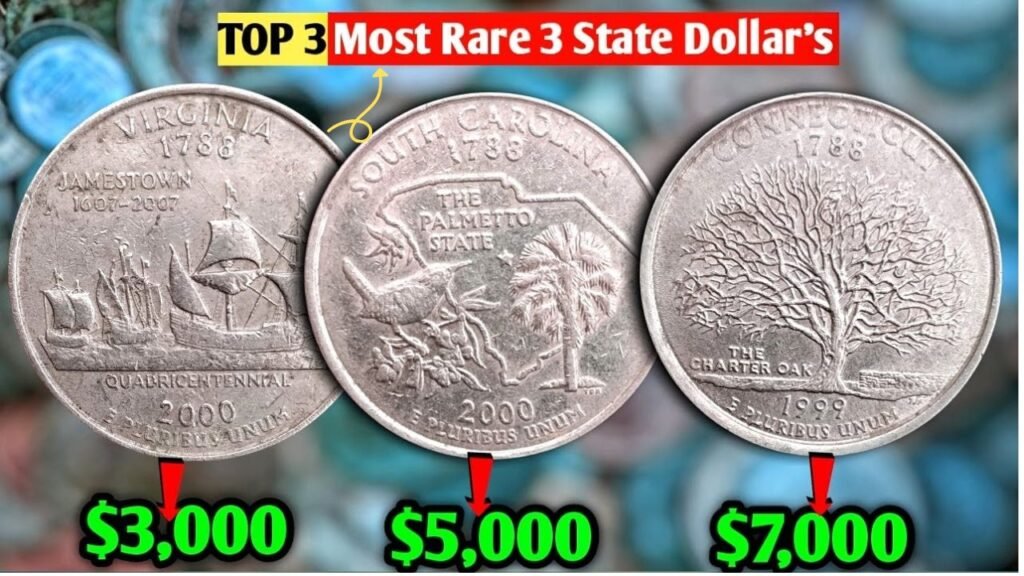

9 Rare Washington Quarters Worth $26,000 Each – Are You Holding One?
We all have loose change. A jar on the dresser, a cup in the car, maybe some coins rattling around at the bottom of a purse. They’re just quarters, right? Used for laundry, parking meters, or a quick snack. But what if I told you that some of those ordinary-looking Washington quarters could be worth a life-changing amount of money? We’re not talking about a few extra dollars. We’re talking about specific quarters that, in top condition, can be valued at a staggering $26,000 or more each.
It sounds unbelievable, but it’s true. The classic Washington quarter, with George Washington’s profile on the front and an eagle on the back, has been in our pockets since 1932. Most are worth exactly 25 cents. But a tiny handful, due to dramatic minting errors or incredibly low production numbers, have become legendary in the coin collecting world. Finding one is like hitting the jackpot. Let’s dive into the nine rare dates and varieties that could turn your pocket change into a small fortune.
The Key to the Treasure: Understanding “Condition”
Before we look at the list, you need to understand one crucial word: grade. A coin’s value is almost entirely tied to its physical condition. A coin that’s been worn smooth from decades of circulation might be rare, but it won’t fetch $26,000. That sky-high value is reserved for coins that look like they just left the mint yesterday—pristine, with full details and original luster. Collectors call these “Mint State” (MS) coins. When we say a quarter is “worth $26,000,” we mean a specific, top-grade example of that quarter. A worn version might still be valuable, perhaps hundreds or a few thousand dollars, which is still amazing! So, check your coins carefully.
Here is a quick overview of the superstar quarters we’re hunting for:
| Year | Mint Mark | Key Variety/Reason for Rarity | Why It’s So Valuable |
|---|---|---|---|
| 1932-D | D | Low Mintage | Only 436,800 were ever minted in Denver. |
| 1932-S | S | Low Mintage | The San Francisco mint made only 408,000. |
| 1934 | (None) | Doubled Die Obverse | Strong doubling visible on “IN GOD WE TRUST.” |
| 1936 | (None) | Doubled Die Obverse | Doubling on the date and lettering. |
| 1937-D | D | Doubled Die Obverse | Clear doubling on the front (obverse) design. |
| 1942-D | D | Doubled Die Obverse | One of the most popular doubled die errors. |
| 1950-D | D | Low Mintage for Era | Just 21 million made, but many were heavily worn. |
| 1950-P/D | (Over D) | Overmint Mark | The “D” mint mark was punched over a “P.” |
| 1970-S | S | Proof Issue, Small Mintage | Only 2.6 million proof quarters made for collectors. |
A Closer Look at These Coin Colossus
Let’s break down why these specific quarters are the holy grails for collectors.
The 1932 D and S Quarters: The Original Rarities
The Washington quarter was first issued in 1932. During the Great Depression, not many coins were needed. The Denver (D) and San Francisco (S) mints produced less than half a million quarters each. People spent them, lost them, and melted them down for silver. Finding one today, especially in uncirculated condition, is incredibly difficult. A gem 1932-D or 1932-S can easily soar past the $26,000 mark.
The Doubled Die Trio: 1934, 1936, and 1937-D
A “doubled die” error happens when the hub (the master design) imprints onto the coin die twice, at slightly different angles. This creates a visible doubling effect on the coin’s design. It’s a dramatic and prized error. The 1934, 1936, and 1937-D quarters all have famous doubled die versions, primarily seen in the wording and date. These are not just “a little blurry”; they show clear, distinct doubling to the naked eye. In top grades, they are worth a fortune.
The 1942-D Doubled Die: The Collector Favorite
This is perhaps the most famous doubled die Washington quarter. The doubling is exceptionally strong on “IN GOD WE TRUST” and the date. It’s a coin that any serious collector dreams of owning. A pristine example is a true museum piece with a price tag to match.
The 1950-D/S: The Overmint Mark Mystery
Normally, a “D” mint mark means Denver, and a “P” (or no mark) means Philadelphia. In 1950, a Denver die was accidentally made with a “P” mint mark. To correct it, a “D” was punched over the “P.” Under a magnifying glass, you can often see the outline of the original “P” beneath the “D.” This quirky error makes the coin highly desirable.
The 1950-D: The “Common” Rarity
With 21 million made, the 1950-D isn’t rare in absolute terms. But it’s the lowest mintage Washington quarter from the 1940s and 1950s. Millions were released and worn down in circulation. Consequently, finding one in brilliant, untouched Mint State condition is a major challenge, making such examples very valuable.
The 1970-S Proof: The Modern Surprise
This one throws people off. It’s not old! In 1970, the San Francisco Mint only made proof quarters—special, mirror-finish coins sold to collectors in sets. They made very few compared to regular coins. Most are still in their original sets, but a lone, flawless 1970-S quarter, if found, is a modern rarity worth a hefty sum.
How to Check Your Change: A Practical Guide
-
Get Organized: Don’t just glance. Sort your quarters by year and mint mark. The mint mark is on the reverse (back) below the eagle’s tail feathers on coins before 1965, and on the obverse (front) to the right of Washington’s ribbon on coins after 1998. For 1965-1998, there are no mint marks for Philadelphia coins, but a “D” (Denver) or “S” (San Francisco, for proofs) may be present.
-
Look for the Key Dates: Pull out any quarters from the years listed above: 1932, 1934, 1936, 1937, 1942, 1950, and 1970.
सम्बंधित ख़बरें
 $2000 IRS Deposit January 2026 – Eligibility Rules, Payment Timeline, and What Americans Should Do Now
 IRS Confirms $2,000 Direct Deposit for All — Payment will be started from 1st January
 Federal $2000 Deposit Expected in December 2025: Eligibility, Payment Schedule, and What Americans Should Know
 IRS finally approved $2,000 Direct Deposit – Payment will started from December 18
 $2,000 Federal Direct Deposit Confirmed — Eligibility Criteria, Payment Timeline, and Claim GuidePowerd By Teckshop⚡
 -
Inspect the Mint Mark: For 1932, you want the D or S. For 1937 and 1942, look for the D. For 1950, the D is critical. For 1970, you need the S.
-
Examine for Errors: For the doubled dies, look closely at the lettering and date. Does it look shadowed or blurred? Use a magnifying glass. For the 1950-D, see if the “D” looks thick or messy—it might be hiding a “P” underneath.
-
Assess Condition: Is the coin worn? Can you see all the strands of Washington’s hair? Is the eagle’s breast feathers detail sharp? The less wear, the better.
Important: If you think you might have one of these, do not clean it! Cleaning a coin drastically reduces its value. Handle it by the edges and place it in a protective holder.
Frequently Asked Questions (FAQs)
1. What if my rare quarter is worn or circulated?
It’s still valuable! While it may not reach the $26,000 peak, a circulated 1932-D or 1950-D/S overmint mark can be worth hundreds or even several thousand dollars. Any example of these keys is worth getting professionally authenticated.
2. I have a silver quarter. Is it valuable?
Washington quarters minted in 1964 and earlier are 90% silver. Their melt value alone is around $4-$5 based on silver prices. So, all pre-1965 quarters have a base precious metal value, which is great! But the rare dates are worth far, far more than their silver content.
3. Where is the mint mark on older quarters?
On all Washington quarters from 1932 to 1964, and from 1968 to 1998, the mint mark is on the reverse (back), just below the center, near the base of the eagle’s tail feathers. Remember: no mint mark means it was made in Philadelphia.
4. Are there any valuable quarters after 1970?
Yes, but not typically in this extreme price range. Modern errors, like the 2004-D Wisconsin state quarter with an extra leaf, or certain 1999-P and 2000-P Sacagawea “Cheerios” dollar coins, can be worth hundreds to a few thousand dollars. The hunt is always on!
5. What should I do if I find one?
First, celebrate carefully! Then, do your research. Compare it closely to online images of certified examples. Finally, consider taking it to a reputable local coin dealer or getting it graded by a professional service like PCGS or NGC. Authentication and grading can solidify its value.
The next time you get a quarter in change, take a half-second to look at it. Check the year. Look for the mint mark. You never know. That little piece of history in your hand might just be hiding a secret worth tens of thousands of dollars. The dream of finding a treasure in everyday life is real, and it starts with looking. Happy hunting